
High Decision Rates in UFC Women's Division Betting
 Available in US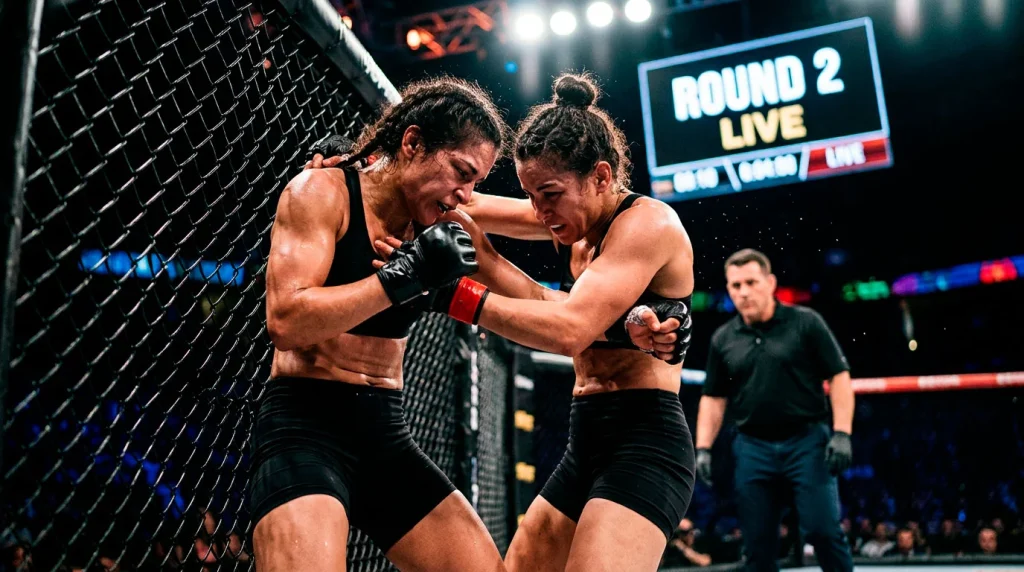
Statistical Patterns for UFC Women’s Division Betting Odds
I learned this lesson the hard way during a UFC Fight Night card in 2022. Three women’s strawweight bouts were on the card, and I backed a knockout or TKO finish in two of them because both featured aggressive strikers with highlight-reel power. All three fights went the full fifteen minutes. Decision, decision, decision. I lost money not because I picked the wrong fighters, but because I applied men’s division logic to a division that operates on entirely different statistical rules.
Women’s strawweight produces a KO/TKO finish in only 13.4% of bouts — the lowest rate of any UFC division by a significant margin. Compare that to men’s heavyweight, where nearly half of all fights end in a knockout. The gap is not subtle. It is a structural reality driven by physical differences in mass, bone density, and striking power at 115 pounds versus 265. In strawweight, 66.9% of fights reach the judges’ scorecards, making it the most decision-heavy division in the entire UFC. If you bet on women’s strawweight the same way you bet on men’s heavyweight, you are ignoring the single most important variable: how fights actually end.
Across the broader UFC, knockouts account for 33.3% of all outcomes and submissions for 19.7%. Women’s divisions pull both of those numbers down significantly, which means the overall averages mask a division-specific reality that sharp bettors exploit.
Finish-Rate Profile Across Women’s Divisions
The UFC currently operates four women’s weight classes: strawweight (115 lbs), flyweight (125 lbs), bantamweight (135 lbs), and featherweight (145 lbs, though this division has been largely inactive and may be discontinued). Each carries a distinct finish profile that shapes how I approach method of victory and over/under rounds markets.
Strawweight is the decision capital of the UFC. The 66.9% decision rate means roughly two out of every three fights go the distance. KO/TKO finishes sit at 13.4%, and submissions account for the remaining portion — approximately 20%. This creates a division where ground control, clinch work, and point fighting dominate outcomes. Fighters like former champion Zhang Weili, who possesses genuine knockout power at 115 pounds, are statistical outliers. Betting on a Weili knockout is reasonable. Betting on a knockout in a random strawweight bout between unranked fighters is fighting the base rate.
Women’s flyweight sits in the middle ground. KO/TKO rates climb slightly compared to strawweight — roughly 18-22% depending on the sample period — and the decision rate drops to around 55-60%. The extra ten pounds of body weight translates into marginally more stopping power, but the division still tilts heavily toward decisions relative to men’s divisions. Valentina Shevchenko’s long reign demonstrated the point: her victories included decisions, submissions, and knockouts in roughly equal measure because she was far more skilled than her competition, not because the division produces finishes frequently.
Women’s bantamweight historically produced the highest finish rate among women’s divisions, partly because the talent pool included power punchers like Amanda Nunes and Holly Holm. With Nunes retired and the division’s depth thinner, current data suggests a slight reversion toward decisions, though KO/TKO rates remain above strawweight at approximately 25-28%.
Decision Betting in Women’s Fights: Where the Data Points
The “fight goes the distance” prop is where I find the most consistent value in women’s UFC betting. In strawweight specifically, the base rate of 66.9% means that a fight reaching the judges’ scorecards is not just likely — it is the default expectation. Yet I regularly see bookmakers pricing “goes the distance” at odds that imply a probability of 55-60%, particularly for matchups between lesser-known fighters where the line-setting receives less attention.
The gap between the implied probability in the odds and the actual statistical base rate is where value lives. When a strawweight bout is priced at “goes the distance” at 4/5 (implied probability roughly 56%), and the historical base rate says 67% of these fights go the distance, that is an eleven-percentage-point edge before you even analyse the specific fighters. You do need to adjust for the specific matchup — two fighters known for aggressive submissions will push the finish probability higher than the divisional average — but the base rate provides a strong anchor.
Over/under rounds markets work on the same principle. In a three-round strawweight fight, the over 2.5 rounds line almost always deserves serious consideration. In a five-round strawweight title fight, over 3.5 or even over 4.5 rounds frequently offers value because the fighters are typically well-matched (title fights generally feature the best in the division) and the power differential that produces early stoppages in men’s heavyweight simply does not exist at 115 pounds.
I also look at specific fighter profiles within the division. A fighter with a 90% decision rate in her last ten bouts fighting another fighter with an 80% decision rate creates a strong case for the distance prop, often at odds that do not reflect just how difficult it is to stop either woman. Contrast this with a matchup involving a prolific finisher — if one fighter has stopped five of her last six opponents, the base rate matters less than the individual tendency.
Are Women’s UFC Fights Mispriced? Thinner Lines and Less Attention
This is the question I return to every fight week, and the answer is nuanced. Women’s fights, particularly outside of title bouts, receive substantially less betting volume than men’s main card fights. Lower volume means bookmakers dedicate fewer resources to sharpening the lines, which creates soft odds more frequently.
I have noticed this pattern most clearly on prelim cards. A women’s strawweight bout between two fighters ranked outside the top ten might attract a fraction of the betting handle that a men’s lightweight bout between similarly ranked fighters generates. The odds for the men’s fight are sharp because hundreds of thousands of pounds in wagers force the bookmaker to tighten the margin. The odds for the women’s fight might sit relatively unchanged from when they opened, reflecting the initial line-setter’s estimate but not the refinement that heavy market activity provides.
This means two things for bettors. First, there is more potential value in women’s fights because the odds are less likely to be perfectly calibrated. Second, the maximum stake limits are often lower, which caps the profitability of any edge you find. Bookmakers protect themselves on thin markets by limiting how much you can bet, so you may find a clear value opportunity only to discover you can wager a maximum of GBP50 on it rather than GBP500.
The information landscape also differs. Casual bettors are less likely to research women’s fighters in depth, particularly at regional level. If you take the time to watch a fighter’s regional MMA bouts before she debuts in the UFC, you hold an informational advantage that barely exists in men’s divisions where debutants are covered extensively by media and handicapping sites. A fighter’s grappling tendencies in smaller organisations often carry directly into her UFC debut because the skill gap at women’s strawweight is wider than in men’s divisions with deeper talent pools.
The method of victory guide breaks down finish-rate data across all divisions including women’s weight classes, but the key insight specific to women’s betting is this: the statistical edge in decision-heavy divisions is not glamorous, it does not produce big-odds winners often, and it requires patience. But it is consistent, exploitable, and underappreciated by a betting public that gravitates toward knockout bets because they are more exciting.
My approach to women’s UFC divisions can be summarised simply. Respect the base rates. Recognise that 115 pounds of athlete produces different outcomes than 265 pounds. Price your bets accordingly, and let the market’s inattention create the opportunities that your analysis can exploit.
Data-Driven UFC Betting Articles UK
UK Betting Access Under the UFC Paramount Media Deal
The Impact of Media Rights on UFC Betting Market Liquidity When the UFC-Paramount deal was announced in August 2025, the headline number got all the attention: $7.7 billion over seven…
Sportsbook Partnerships & UFC Betting Sponsorship Revenue
The Influence of Sportsbook Money on UFC Broadcasts When I started watching…
Division-Level Data & UFC Betting Statistics 2026
Analyzing Favourite Win Rates in UFC Betting Statistics Nine years of analysing…
Track Record Verification & UFC Betting Tipsters
Evaluating Yield versus Win Rate in UFC Tipsters I followed a UFC…
Written by the editors at OctaEdge.
