
Fractional & Decimal UFC Betting Odds UK
 Available in US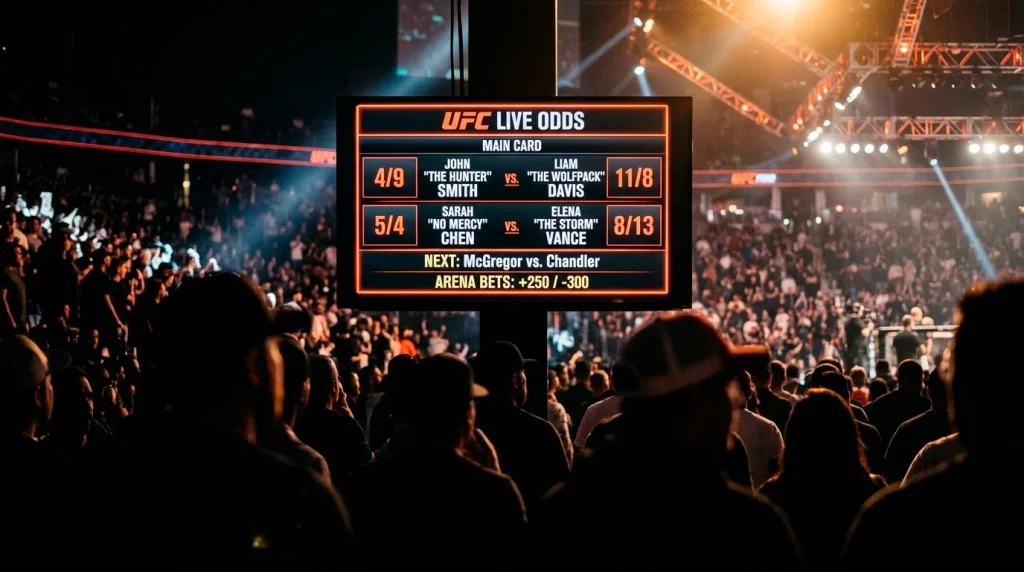
Fractional, Decimal, and American UFC Odds Comparison
I placed my first UFC bet in 2017 on a flyweight fight in Perth, and the thing that nearly sank me was not bad fight analysis – it was misreading the odds. I saw 4/6 next to one name and 5/4 next to the other, and I genuinely thought the bigger number meant the bigger payout per pound staked. It does, but not in the way I assumed. That misunderstanding cost me about forty quid before I sat down and actually learned what those numbers meant.
Every UFC fight card published by a UK bookmaker presents you with three pieces of information compressed into a pair of fractions or decimals: who the market thinks will win, by how much, and what the bookmaker charges you for the privilege of wagering. Those three layers – probability, payout, and margin – sit inside every price you see, whether it is a main event headliner or a prelim bout between two fighters you have never heard of. The UK gambling industry generated GGY of 11.5 billion pounds in the year ending March 2024, and a growing slice of that comes from combat sports markets that did not even exist on most platforms a decade ago.
This guide breaks down how UFC odds work in each format you will encounter as a UK punter – fractional, decimal, and American – and then goes further into the mechanics most guides skip: implied probability, bookmaker overround, line movement, and how to read an entire fight card’s odds structure from prelims to main event. By the end, you will look at a set of UFC odds and see a story the bookmaker is telling, rather than a random pair of numbers.
One thing to flag early: understanding odds formats is mechanical. You can learn it in an afternoon. The skill that takes years is knowing when the story the odds tell conflicts with the story the fight data tells. That gap – between what the market implies and what the numbers suggest – is where every profitable UFC bet lives. But you cannot exploit gaps you cannot read, so let’s start with the reading.
Fractional Odds: The UK Standard for UFC Betting
Walk into any betting shop in the UK or open a domestic sportsbook app and the default format you will see for UFC fights is fractional odds. They look like this: 4/6, 5/4, 11/8, 1/3. If you grew up betting on horses at the Grand National, this format is second nature. If you came to UFC from watching American MMA coverage, it looks like hieroglyphics. Either way, the maths behind fractions is the simplest system to learn once you see the pattern.
A fractional odd tells you one thing: for every unit you stake equal to the number on the right, you profit the number on the left. At 5/4, you profit five pounds for every four you stake. At 4/6, you profit four pounds for every six you stake. Your original stake comes back on top of that profit, so a ten-pound bet at 5/4 returns 22.50 pounds total – twelve fifty in profit plus your tenner back.
The formula is straightforward: Total Return = Stake x (Numerator / Denominator + 1). Let me walk through a concrete UFC example. Imagine a welterweight fight where Fighter A is priced at 4/6 and Fighter B sits at 5/4. You fancy Fighter A, the favourite, and place twenty pounds on the moneyline. Your calculation: 20 x (4/6 + 1) = 20 x 1.6667 = 33.33 pounds returned, with 13.33 pounds as profit. If you back Fighter B instead with the same twenty-pound stake: 20 x (5/4 + 1) = 20 x 2.25 = 45 pounds returned, with 25 pounds profit.
Notice the asymmetry. The favourite gives you less profit than your stake. The underdog gives you more. That relationship is the entire logic of odds in a nutshell – the market is compensating you for taking on more risk. The shorter the fraction (1/5, 1/8, 1/12), the heavier the favourite and the smaller your return per pound risked. The larger the fraction (3/1, 5/1, 10/1), the bigger the implied upset and the bigger your potential profit.
A common trap for new UFC bettors is treating fractional odds as fixed categories. “Odds-on” means any price where the denominator exceeds the numerator – 4/6, 1/2, 2/7 – indicating the fighter is expected to win more often than not. “Odds-against” is the reverse: 5/4, 7/2, 3/1. “Even money” or “Evens” is 1/1, implying a coin-flip probability before margin. In UFC, true even-money fights are rare. Most main events feature a clear favourite, and prelim bouts can swing anywhere from 1/10 to 4/1 depending on the matchup.
One practical tip: when comparing two fractional prices quickly in your head, convert both to “how much do I get back per pound staked” by dividing the first number by the second and adding one. Fighter A at 4/6: 0.667 + 1 = 1.667 per pound. Fighter B at 5/4: 1.25 + 1 = 2.25 per pound. That mental shortcut saves time when you are scanning a full fight card with twelve or thirteen bouts listed.
Decimal and American Odds: Converting Between Formats
Most European sportsbooks default to decimal odds, and if you have ever used a betting exchange, decimals are likely your native language. The conversion from fractional to decimal is trivially simple: divide the fraction and add one. Our 4/6 favourite becomes 1.667. Our 5/4 underdog becomes 2.25. The decimal figure tells you the total return per pound staked, including your original stake – no separate mental step for “plus my money back.”
I switched to decimals about three years into my UFC betting because comparing prices across bookmakers is faster when you do not have to mentally process fractions. Is 11/8 better or worse than 7/5? In decimal: 2.375 versus 2.40. The second price is better. Takes half a second. In fractional form, you are cross-multiplying in your head while the odds are moving.
American odds – also called moneyline odds – are the standard in the United States and show up constantly in UFC content because the sport’s heartland is American. Positive American odds (+150, +200, +400) tell you how much profit you make on a 100-dollar stake. Negative American odds (-150, -200, -400) tell you how much you need to stake to profit 100 dollars. Fighter A at 4/6 fractional converts to -150 American: you need to risk 150 to profit 100. Fighter B at 5/4 converts to +125 American: a hundred-dollar stake profits 125.
The conversion formulas are worth memorising if you consume American MMA media:
Fractional to Decimal: (Numerator / Denominator) + 1. So 5/2 = 3.50.
Decimal to American: if decimal is 2.00 or above, American = (Decimal – 1) x 100. So 3.50 becomes +250. If decimal is below 2.00, American = -100 / (Decimal – 1). So 1.667 becomes -150.
American to Decimal: if positive, Decimal = (American / 100) + 1. So +250 = 3.50. If negative, Decimal = (100 / absolute value of American) + 1. So -150 = 1.667.
You do not need to memorise every formula. Most UK sportsbooks let you toggle between formats in settings. The reason I walk through the maths is that when you read American UFC analysis – and you will, because the sharpest MMA content comes from US-based analysts – you need to instantly translate -180 or +220 into something your brain can price. A fighter at -180 is roughly 1.556 decimal or 5/9 fractional. That is a solid favourite, but not an overwhelming one. A fighter at +220 is 3.20 decimal or 11/5 – a meaningful underdog with real upset potential.
Implied Probability: Turning Odds into Win Percentages
Here is where odds stop being just a payout calculator and start being a tool for finding profitable bets. Every set of odds implies a probability – the market’s estimate of how likely a fighter is to win. When that implied probability is wrong, and you can identify why, you have found what UFC betting strategy calls a value bet.
The formula is clean: Implied Probability = 1 / Decimal Odds x 100. Fighter A at 1.667 decimal implies a win probability of 59.9%. Fighter B at 2.25 implies 44.4%. Add those together: 104.3%. That total exceeds 100%, and the excess is the bookmaker’s margin – but we will cover that in the next section.
Why does this matter practically? Because in 2024, favourites won approximately 72% of UFC bouts. If a bookmaker prices a fighter at 1.667 decimal, they are implying roughly a 60% chance of winning. But if your own analysis – based on style matchup, recent form, divisional trends – suggests that fighter actually has a 70% chance, the odds are offering you better value than the true probability warrants. You are getting underdog-like payouts on a near-favourite probability.
I run implied probability calculations on every fight I consider betting. It takes seconds and immediately filters out poor-value wagers. A heavily backed favourite at 1.20 decimal implies 83.3% win probability. Favourites across the entire UFC win 72% of the time on average. For that price to represent value, you need to believe this specific fighter in this specific matchup wins more than 83% of the time – which is a much higher bar than “I think he’ll probably win.”
The gap between implied probability and your estimated true probability is your edge. A positive edge means the bet has positive expected value over time. A negative edge means the bookmaker has priced it correctly or overpriced the fighter relative to their actual chance. No amount of fight knowledge helps if you skip this step, because you can correctly predict the winner and still lose money if you consistently bet at odds that imply a higher probability than reality delivers.
One practical approach: before looking at odds for any UFC fight, write down your own probability estimate for each fighter. Be honest. Then check the implied probability from the bookmaker’s price. If your number is meaningfully higher than the implied probability – I use a threshold of at least five percentage points – the bet deserves a closer look. If the numbers are close or the bookmaker’s implied probability exceeds yours, move on regardless of how confident you feel about the pick.
Bookmaker Overround and Margin: Where the House Edge Hides
A friend once asked me why bookmakers always seem to win in the long run. I showed him a two-fighter UFC market where the implied probabilities added up to 106%. “Where does the extra six percent go?” he asked. That six percent is the overround – the bookmaker’s built-in profit margin on every market they offer, and it is the single most overlooked concept in UFC betting education.
In a theoretically fair market with no margin, implied probabilities of both fighters would sum to exactly 100%. Fighter A at 60%, Fighter B at 40%. In reality, the bookmaker inflates both sides. Fighter A’s odds imply 62%, Fighter B’s imply 44%. Total: 106%. That extra 6% is the overround, sometimes called the “vig” or “juice.” It means that even if you bet both sides of the same fight, you would lose money – the bookmaker has already priced in their cut.
The UK remote gambling sector generated GGY of 6.9 billion pounds in the year to March 2024, growing at 6.9% year-on-year. Overround is one of the mechanisms that feeds that revenue. For UFC markets specifically, margins tend to run between 4% and 8% on main event moneylines at the larger UK-licensed operators. Smaller operators or less liquid markets – early prelim fights, method of victory props, grouped round bets – can carry overrounds of 10% to 15% or even higher.
Why should you care about a few percentage points? Because overround directly erodes your long-term returns. If you are betting at an average overround of 6%, you need to be right more often than the raw probabilities suggest just to break even. Over hundreds of bets, a 2% difference in average overround between two bookmakers compounds into a significant difference in bankroll trajectory. This is why experienced UFC bettors hold accounts with multiple operators and always check where the best price sits for each fight.
To calculate overround yourself: convert each fighter’s odds to implied probability, sum them, and subtract 100. Decimal odds of 1.70 and 2.30 for a two-fighter market give you (1/1.70 + 1/2.30) x 100 = 58.8% + 43.5% = 102.3%. The overround is 2.3% – a tight, competitive market. Odds of 1.55 and 2.60 give you 64.5% + 38.5% = 103.0%. Still reasonable. Odds of 1.40 and 2.80 give you 71.4% + 35.7% = 107.1%. That 7.1% overround is steep, and you are paying a heavy tax on every wager in that market.
Betting exchanges operate on a different model entirely – they charge a commission on winning bets (typically 2% to 5%) rather than building margin into the odds. This means exchange odds often represent closer to “true” probabilities, and the effective overround can drop to 1% or 2%. For UFC fights with sufficient liquidity on exchanges, this can meaningfully improve your returns over time.
Why UFC Odds Move: Injury News, Weight Cuts, and Sharp Money
I once watched a UFC lightweight fight’s odds shift from 2/5 to 4/7 in the space of thirty minutes on a Wednesday afternoon. No news had broken publicly. No injury announcement. No social media drama. What happened was sharp money – informed bettors placing significant sums on one side – and the bookmaker adjusting their prices to manage liability. By Thursday morning, the original fighter’s trainer had posted a cryptic Instagram story about “trusting the process through setbacks.” By Friday, the fighter’s opponent was a short-notice replacement. The line had already moved.
UFC odds are not static. They open days or weeks before an event and shift continuously based on three forces: money flow, information, and the bookmaker’s own risk management. Understanding why lines move – and when movement signals genuine new information versus noise – is a skill that separates experienced UFC bettors from casual punters.
Money flow is the most straightforward driver. When disproportionate volume lands on one side of a fight, bookmakers shorten that fighter’s odds and lengthen the other’s to balance their book. Sharp money – wagers from accounts the bookmaker has flagged as consistently profitable – triggers faster, larger adjustments than recreational money. If you see a sudden odds shift with no apparent news catalyst, sharp action is the most likely explanation.
Information-driven movement is more transparent. Injury reports, training camp footage, weight cut concerns, and opponent changes all reshape the market. The global number of MMA events has grown from roughly 100 in 2020 to over 180 projected by 2025, and the UFC alone runs 42 to 43 events annually. That density means news breaks constantly, and odds react in real time. A fighter photographed looking gaunt at a pre-fight press conference. A grappling coach switching camps. A visa issue delaying travel. Each of these can move a line by several percentage points.
Thomas Gable, director of Borgata Race and Sportsbook, noted that recreational bettors have pulled back from UFC markets following integrity concerns, while regulars and sharp bettors remain active. That dynamic affects line movement patterns – with fewer casual bettors in the market, sharp action has an outsized impact on odds, and lines can move faster and further than they would in a higher-liquidity sport like football.
The practical takeaway: track opening odds and compare them to closing odds (the price available at fight time). If you consistently bet at prices that are better than the closing line, you are capturing value the market later removes. If you consistently bet at prices worse than the close, the market is smarter than your analysis. Closing line value is the single best long-term metric for evaluating your own UFC betting performance, and it starts with understanding that odds are a living, breathing reflection of information – not a fixed label stamped on a fight.
Reading a UFC Fight Card: A Walkthrough from Prelims to Main Event
Let me walk you through a hypothetical UFC Fight Night card the way I read one when it drops. Twelve fights, four on the early prelims, four on the main prelims, four on the main card. Each fight tells a different story through its odds, and reading the full card as a connected set of markets – rather than twelve isolated bets – changes how you approach the evening.
Start at the top: the main event. Suppose it is a middleweight five-rounder with the favourite priced at 1.45 decimal and the underdog at 2.90. Implied probabilities: 69% and 34.5%, overround 3.5%. Tight market, high confidence in the favourite, and the bookmaker is not charging much margin – this is a high-liquidity fight that the market has priced efficiently. Making money here is harder because the odds already reflect a deep well of information.
Drop to the co-main event. A women’s bantamweight three-rounder: favourite at 1.30, underdog at 3.60. Implied probabilities: 76.9% and 27.8%, overround 4.7%. The margin is wider here. Less media attention, fewer sharp bettors scrutinising the matchup, and potentially more room for the odds to be wrong. Also note: across UFC bouts overall, KO/TKO accounts for 33.3% of all finishes, but in women’s divisions the knockout rate drops dramatically – women’s strawweight sees just 13.4% of fights end by KO/TKO. If this women’s fight is priced with method-of-victory markets that do not adequately reflect those divisional tendencies, there may be value in specific outcome bets.
Now scan the prelims. The early prelims often feature debuting fighters, short-notice replacements, or regional-circuit veterans stepping up. The odds here tend to be wider – both in terms of the spread between favourite and underdog, and in terms of overround. A prelim fight priced at 1.15 versus 5.50 has an implied overround of 105.1%, which is manageable, but the 1.15 price implies the favourite wins 87% of the time. At that level, you need extraordinary confidence in the pick to justify the return.
What I look for across the full card is a pattern in overrounds. Main card fights typically carry tighter margins because liquidity is higher. As you move down the card, margins widen, but so does the potential for mispricing. The best opportunities – fights where the bookmaker’s implied probability meaningfully diverges from your own estimate – tend to cluster in the lower half of fight cards, where less public attention means less market efficiency.
One more thing: fight order is not random. The UFC structures its cards to build momentum, which means the most evenly matched fights often sit in the middle of the main card, while the prelims feature a mix of mismatches and genuine toss-ups. Reading the card from bottom to top, rather than fixating on the headliner, is a habit that has consistently improved my returns. The fights no one talks about are the fights where the market is least likely to be right.
Common Questions About UFC Betting Odds
Data-Driven UFC Betting Articles UK
ROI Tracking & UFC Betting Record Keeping
Essential Metrics for UFC Betting Performance Tracking For the first eighteen months of my UFC betting, I kept no records. I remembered the wins vividly — the underdog knockout at…
Knockout, Submission & UFC Method of Victory Odds
Division-Level Finish Rates for Method of Victory Bets Most UFC bettors fixate…
Market Depth & UFC vs Bellator Betting Differences
Rule Variations Influencing UFC and Bellator Betting Odds A friend of mine…
UK Market Odds & UFC Betting for Beginners
Comparing UFC Betting Markets to Traditional Sports I spent three years betting…
Prepared by the OctaEdge editorial staff.
