
Performance Markets & UFC Prop Bets in the UK
 Available in US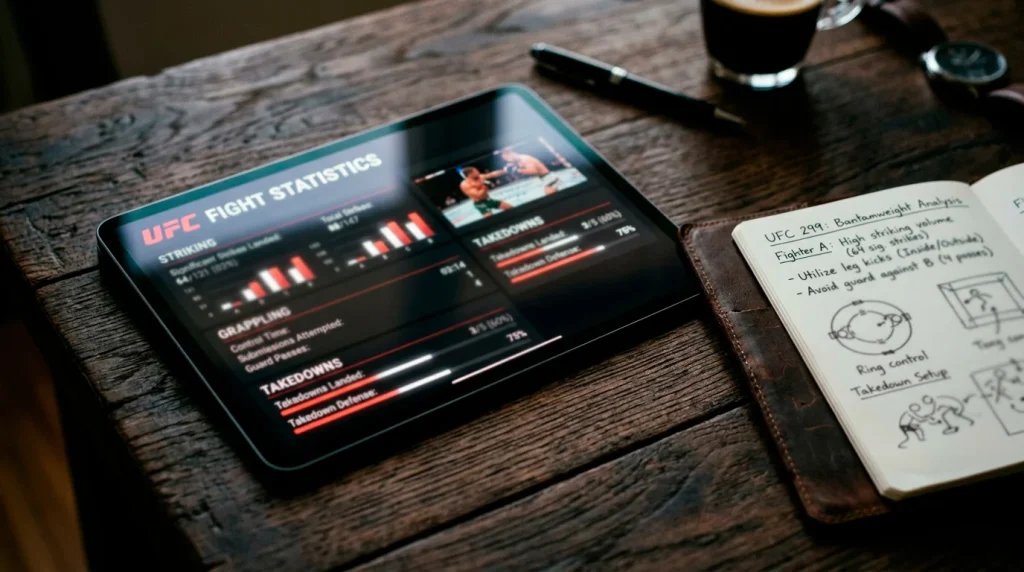
Analyzing Fighter-Specific UFC Prop Bet Markets
The moment I stopped treating UFC as a “pick the winner” exercise was the moment my returns improved. It happened during a card where I was certain a wrestler would dominate a striker but the moneyline sat at 1/4 — too short to justify the stake. Then I looked at the prop markets. “Fight goes the distance” was priced at 5/6. “Total significant strikes over 120.5” was even money. Suddenly, the same analytical conclusion — dominant wrestler grinds out a decision — was available at three times the moneyline value through different market windows.
Prop bets, short for proposition bets, ask questions about specific events within a fight rather than the outcome itself. They transform one bout into a dozen distinct wagering opportunities, each priced according to its own probability curve. For punters willing to dig into fighter-level statistics, props offer edges that the moneyline market simply cannot provide. KO/TKO finishes represent 33.3% of UFC results, but the “fight to not go the distance” prop captures all finishes regardless of method — knockouts and submissions combined — which changes the maths considerably.
Fight-Specific Props: Distance, Finish Type, and Total Rounds
Three years ago, I started logging every fight-specific prop I bet alongside the result. The market where I have found the most consistent edge is “fight goes the distance” — yes or no. This prop is effectively a binary bet on whether the fight reaches the judges’ scorecards. In heavyweight, where nearly half of all bouts end by knockout and only 28.6% reach a decision, the “no” side of this market carries a strong base rate. In women’s strawweight, where 66.9% of fights go to decision, the “yes” side is the statistically favoured outcome.
The edge appears when bookmakers price the prop based on fighter name recognition rather than divisional base rates. A heavyweight bout between two moderate punchers might be priced as if it carries the same finishing probability as a matchup between two knockout artists — because both fights are “heavyweights.” Digging into individual striking output and accuracy separates the genuine finish threats from the plodders.
Over/under rounds is a related market with a different structure. The bookmaker sets a line — typically 1.5 or 2.5 for a three-round fight, and 2.5 or 3.5 for a five-round championship bout — and you bet whether the fight finishes before or after that point. The key difference from “goes the distance” is granularity: over 1.5 rounds wins even if the fight ends in round two, whereas “goes the distance” requires all scheduled rounds to be completed. That distinction matters more than most punters realise, particularly in round betting approaches where the timing of the finish is the core variable.
Total rounds as a market also interacts with fighter tendencies in non-obvious ways. A fighter who typically finishes opponents in round two creates a natural “under 2.5” lean, but only if the opponent is susceptible to finishing. Against a durable fighter with strong defensive grappling, the same finisher might be taken into deep waters for the first time. The prop market does not always account for this matchup-specific adjustment.
Fighter-Specific Props: Strikes, Takedowns, and Performance Bonuses
Fighter-specific props zoom in even further, asking about individual statistical outputs within the fight. These markets are less commonly available at UK bookmakers than fight-level props, but when they appear — typically for main events and pay-per-view headliners — they can carry significant value for punters with access to detailed fight statistics.
Total significant strikes is the most common fighter prop. The bookmaker sets a line — say, Fighter A over/under 85.5 significant strikes — and you bet the direction. This requires knowing not just how many strikes a fighter throws per minute, but how long the fight is likely to last. A fighter who averages 5.0 significant strikes per minute will comfortably clear 85.5 in a three-round decision but will fall well short if the fight ends by first-round knockout. The prop is a joint bet on output rate and fight duration, whether the bookmaker frames it that way or not.
Takedown props — Fighter A over/under 2.5 takedowns — reward knowledge of grappling dynamics. A wrestler facing a striker with poor takedown defence in a five-round fight might attempt eight or nine takedowns. The same wrestler against an opponent with 85% takedown defence might attempt three and land one. The over/under line rarely adjusts enough for these extreme matchups, particularly on the undercard where the bookmaker’s pricing model gets less attention.
Performance bonus props — “will this fight win Fight of the Night or Performance of the Night?” — are pure entertainment bets with almost no analytical basis. The bonuses are awarded subjectively by UFC officials after the event, and the criteria shift from card to card. I steer clear of these entirely. The margin is enormous, the outcome is unmodellable, and the only winner is the operator.
Common Prop Bet Pitfalls and How to Avoid Them
The biggest pitfall is treating props as if they are independent of the moneyline outcome. They are not. If you bet “Fighter A over 85.5 significant strikes” and also bet “Fighter A to win by KO in Round 1,” those positions conflict — a first-round knockout almost certainly means Fighter A throws fewer than 86 significant strikes. I have made this exact mistake, placing two bets on the same fight that could not both win. It felt like hedging. It was not. It was paying double the bookmaker’s margin for a guaranteed partial loss.
The second pitfall is overreliance on career averages. A fighter’s career significant strikes per minute is an aggregate that includes bouts against wildly different opponents, at different points in their career, sometimes across different weight classes. The relevant number is their output against stylistically similar opponents in the same weight class over the last two to three years. That sample might be only three or four fights, but it is far more predictive than a fifteen-fight career average that includes their debut against a regional journeyman.
Liquidity is a practical concern too. Prop markets on UFC undercard fights are thin. The odds might look attractive, but the maximum stake the bookmaker accepts could be ten or twenty pounds. If you are used to staking fifty or one hundred pounds on moneyline singles, the props market may not accommodate your bankroll. And if you are placing props at maximum stake on every fight, you are signalling to the operator that you know what you are doing — which can lead to account restrictions faster than any other market.
Finally, check settlement rules for props before you place the bet. “Total strikes” versus “total significant strikes” are different statistics, and some operators define “significant strikes” differently from the UFC’s official count. A bet that looks like a winner based on the broadcast statistics can settle as a loser if the bookmaker uses a different data provider. Read the terms once, bookmark the relevant page, and never assume.
Data-Driven UFC Betting Articles UK
Global Handle & UFC Betting Market Growth
Key Drivers Behind the UFC Betting Market Expansion When I started tracking UFC odds seriously in 2017, MMA was a sideshow on most sportsbooks — buried under three navigation layers,…
Historical Data & UFC Underdog Win Rate Analytics
High-Odds Upset Trends in UFC Underdog Betting I remember checking the numbers…
Machine Learning Models for UFC Betting AI Predictions
Data Inputs Used in UFC AI Betting Prediction Models I built my…
Title Markets & UFC Futures Betting in the UK
Securing Early Value in UFC Title Fight Futures Most of my UFC…
Prepared by the OctaEdge editorial staff.
