
Polymarket Crowd Odds vs Traditional UFC Bookmakers
 Available in US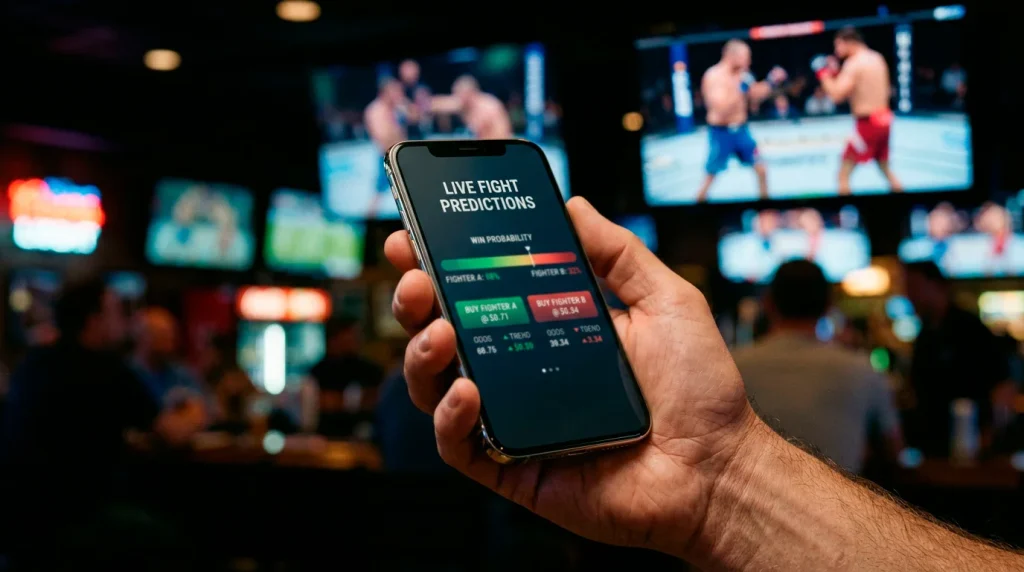
Analyzing Public Sentiment in UFC Prediction Markets
The first time I saw a UFC fight priced on a prediction market, my immediate reaction was scepticism. A crowd of anonymous internet participants setting odds on a fistfight — how could that compete with a professional trading desk at a licensed bookmaker? Then I compared the prediction market price to the sportsbook line on the same fight, and the prediction market was closer to the closing line. One event is not evidence. But it was enough to make me pay attention.
Prediction markets operate on a fundamentally different model from traditional bookmakers. Instead of a single entity setting odds and accepting bets against itself, a prediction market creates a marketplace where participants buy and sell shares in outcomes — effectively crowd-sourcing the probability estimate. Mark Shapiro, president of TKO Group Holdings, has described the utility of platforms like Polymarket as an information and fan engagement tool, comparing it to how CNN or CNBC integrates prediction market odds into their reporting. The UFC sees these markets not as competitors to traditional betting but as a real-time sentiment gauge that enhances the fan experience.
How UFC Prediction Markets Differ from Traditional Bookmakers
A traditional bookmaker sets the odds, takes both sides of the market, builds in a margin (the overround), and profits from the difference between what they pay out and what they collect. They are the house. Their odds reflect a combination of their probability assessment, their liability exposure, and their margin requirements. The bookmaker’s incentive is to attract balanced action on both sides of a fight and pocket the overround.
A prediction market eliminates the house. Participants trade shares that pay out a fixed amount — typically one dollar or one pound — if a specific outcome occurs. If you believe Fighter A will win and the current share price is 55 cents, you buy at 55 cents and receive $1 if Fighter A wins. Your profit is 45 cents per share. If Fighter A loses, you lose your 55-cent investment. The share price itself is the crowd’s implied probability: a 55-cent price implies a 55% chance of winning.
The structural difference matters for price accuracy. A bookmaker has a built-in margin that distorts the true probability. If the bookmaker’s true assessment is 55% for Fighter A and 45% for Fighter B, the odds will imply approximately 57% and 47% (totalling 104%) — the extra 4% is the overround. Prediction market prices do not include a built-in overround because there is no house to take a margin. The combined implied probabilities of all outcomes in a prediction market should sum to close to 100%, with small deviations from platform fees and bid-ask spreads.
This structural efficiency means prediction markets can, in theory, produce more accurate probability estimates than bookmakers — at least for events where enough participants trade to form a liquid market. The question is whether UFC attracts sufficient prediction market volume to achieve that accuracy.
Polymarket and UFC: The TKO Group Holdings Partnership
Polymarket has positioned itself as the most prominent prediction market for sports, politics, and cultural events, and UFC has been a growing category on the platform. The relationship with TKO Group Holdings gives Polymarket access to UFC branding and fight data, while giving UFC a new channel for fan engagement that does not carry the regulatory overhead of licensed sports betting.
The volume on Polymarket UFC markets varies enormously by event. High-profile pay-per-view main events — title fights, grudge matches, McGregor returns — attract significant liquidity, with total market volume reaching six figures. Prelim fights and Fight Night main events draw far less activity, sometimes in the low thousands. That liquidity disparity means Polymarket prices are most informative for the same fights where bookmaker pricing is already tightest and most efficient. On undercard bouts, where pricing inefficiencies are more likely, prediction market liquidity is too thin to produce reliable probability estimates.
One advantage Polymarket offers is real-time price movement that is unfiltered by bookmaker risk management. When sharp money enters a traditional sportsbook, the operator may adjust the line slowly or limit the bettor’s stake to manage exposure. On Polymarket, every trade moves the price immediately and transparently. If a large buyer enters the market on Fighter B, the share price for Fighter B rises instantly, and every participant can see the shift. This transparency provides a cleaner signal of where informed money is flowing than traditional bookmaker line movement, which is muddied by internal liability management.
Using Prediction Market Prices as a Supplementary Betting Signal
I treat prediction market prices as a third data point alongside bookmaker odds and my own assessment. The bookmaker tells me what the house thinks. Polymarket tells me what the crowd thinks. My analysis tells me what I think. When all three align, the fight is likely priced correctly, and I pass unless I have a strong specific conviction. When they diverge, there is something worth investigating.
The most useful signal comes when prediction market prices and bookmaker prices disagree on the same fight. If Polymarket has Fighter A at 60% and the bookmaker implies 52%, either the crowd is overvaluing Fighter A or the bookmaker is undervaluing them. Figuring out which requires research — looking at why the crowd might be biased (recency bias after a viral knockout, hometown hype, media narratives) versus why the bookmaker might be mispriced (thin market, delayed reaction to news, legacy pricing from the opening line).
Underdogs at +200 or longer won 39% of UFC fights in 2024, and prediction markets can sometimes flag these upsets before the bookmaker adjusts. If the prediction market price on an underdog climbs from 25 cents to 35 cents over fight week while the bookmaker odds barely move, that divergence suggests informed participants are backing the underdog on the prediction market before the information reaches the traditional sportsbook. I have caught three value bets this year by monitoring Polymarket prices alongside bookmaker odds and noticing exactly this pattern.
The limitation is that prediction markets for UFC are still maturing. Liquidity is inconsistent, the participant base skews towards US-based traders who may not be accessible to UK residents under certain regulatory conditions, and the platform itself carries counterparty risk that a UKGC-licensed bookmaker does not. Use prediction market prices as an analytical input, not as a betting venue — unless you have verified the legal and regulatory status of prediction market participation in your jurisdiction. The odds comparison framework shows how to integrate multiple price sources into a practical fight-night workflow.
Data-Driven UFC Betting Articles UK
Mathematical Frameworks for Finding UFC Value Bets
Calculating Implied Probability for UFC Value Bets I once backed a fighter I was almost certain would lose. She was priced at 7/2 — the market gave her roughly a…
Remote Gaming Duty & UFC Betting Tax Changes UK
The Impact of General Betting Duty on UFC Odds On 1 April…
Late Swaps & UFC Short-Notice Replacement Betting
Evaluating Betting Odds After UFC Fighter Replacements I had a confident method…
Outright Winner Odds & UFC Moneyline Betting
Identifying Value in UFC Moneyline Betting Markets Every punter I have ever…
Written by the editors at OctaEdge.
