
Undercard Value Analytics for UFC Prelim Bets
 Available in US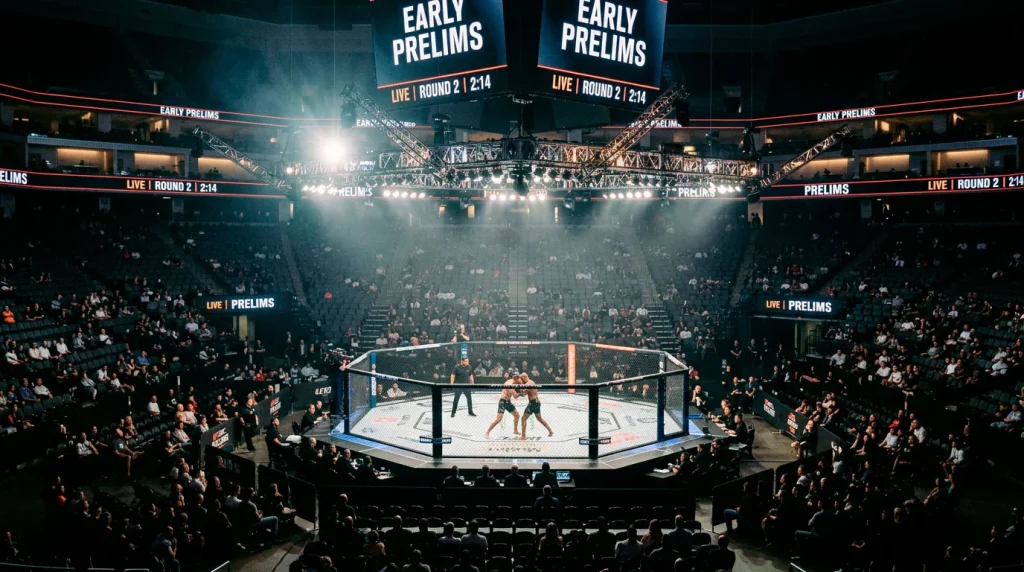
Finding Profitable Odds in UFC Undercard Fights
Most UFC bettors I know spend their research time on the main card. They study the headliner, watch embedded vlogs featuring the top five fighters, and place their bets on the names they recognise. The prelims — typically four to six fights featuring lesser-known athletes — get a cursory glance at best. I used to do the same thing until I started tracking my results by card position and discovered something I should have noticed earlier: my yield on prelim bets was consistently higher than my yield on main card bets.
The reason is straightforward. With the UFC staging 42-43 events annually and the number of global MMA events reaching an estimated 180-200 per year, the volume of fights is enormous. Bookmakers dedicate their sharpest odds-setters and biggest resources to the fights that attract the most money — the main events and co-main events. Prelim fights, especially early prelims, receive less market attention, less media scrutiny, and consequently softer lines. The odds on a main event title fight are hammered into precision by millions in wagers. The odds on two unranked fighters opening a Fight Night card are often set once and barely adjusted.
This asymmetry is your opportunity. The information needed to evaluate prelim fighters exists — it just requires more effort to find than reading the headline analysis on the main event.
Why Prelim Odds Are Often Softer Than Main Card Odds
Bookmaker odds are a function of two things: the line-setter’s initial estimate and the market activity that follows. For a main event between ranked fighters, thousands of bettors place wagers within hours of the odds opening. This volume forces bookmakers to adjust their lines continuously, correcting any initial mispricing. By fight night, the main event odds are typically sharp — close to the true probability as the market collectively sees it.
Prelim fights attract a fraction of that volume. Betting handle on MMA reached $10.3 billion in 2024, but that total is heavily concentrated on high-profile bouts. A fight between two debutants on the early prelims might generate a few thousand pounds in total wagers at a UK bookmaker — not enough to force meaningful line corrections. The odds you see when the market opens might be almost identical to the odds at fight time, which means any error in the initial pricing persists uncorrected.
I have noticed this pattern most clearly with fighters transitioning from regional promotions. A fighter who dominated a smaller organisation — winning eight straight in Cage Warriors or BAMMA — will sometimes open as a modest favourite or even a pick’em in their UFC debut because the line-setter does not have extensive UFC data to work with. Meanwhile, an experienced bettor who watched those regional fights or studied the opponent’s record in detail can often identify when the opening line undervalues the debutant or overvalues the more experienced but limited UFC fighter they are facing.
The margin structure also plays a role. Bookmakers apply wider margins to fights with less data, protecting themselves against uncertainty. That margin cuts both ways — it means you need a larger edge to profit, but it also means the odds are set more conservatively, sometimes creating situations where the favourite is underpriced because the bookmaker widened the margin on the underdog side disproportionately.
Researching Lesser-Known Fighters: Regional Records and Camp Intel
This is where prelim betting demands work that most casual bettors will not do, which is precisely why the edge exists. Favourites win approximately 72% of UFC fights overall, but in prelim bouts featuring fighters with fewer than five UFC appearances, the variance increases because the data set is smaller and the predictability is lower.
My research process for prelim fighters starts with their regional record. Sites like Tapology and Sherdog maintain comprehensive fight records including opponents, results, methods of victory, and round of finish. I look for patterns: does the fighter consistently finish opponents, or do they grind out decisions? What is their record against fighters who have subsequently appeared in the UFC? A regional fighter who beat three future UFC competitors in smaller promotions carries more credibility than one who accumulated ten wins against opponents with 2-5 records.
Camp affiliation matters more in prelim analysis than main card analysis. A fighter training at a top-tier gym — American Top Team, City Kickboxing, Tiger Muay Thai — benefits from elite sparring partners, better coaching, and more structured preparation. A fighter from a smaller gym in a region without a strong MMA infrastructure may have an impressive record built against weaker competition. This does not mean the smaller-gym fighter will lose, but it adjusts the probability estimate.
Social media and fighter interviews provide a surprisingly useful data layer for prelim bouts. Because these fighters receive less media coverage, any information you gather — a fighter mentioning a nagging injury, a change in training camp, or a visible weight-cut struggle on social media — is less likely to be priced into the odds. In main event analysis, this type of information spreads rapidly through betting communities and adjusts the line within hours. In prelim analysis, it might never reach the market at all.
I also check the fight stats guide for context on which statistics carry the most predictive weight. For prelim fighters with limited UFC data, I rely more heavily on stylistic analysis — striker versus grappler, cardio indicators from fight footage, and how they handle adversity when hurt — because the statistical sample from two or three UFC bouts is too small to be reliable on its own.
Prelim-Specific Risks: Late Changes, Thin Markets, and Low Limits
Prelim betting carries risks that main card betting does not. The most significant is late changes. Prelim fights are the first to be affected by card reshuffling. If a main card fight falls through due to injury or weight miss, the UFC frequently promotes a prelim fight to the main card and sometimes cancels or restructures a prelim bout entirely. This can leave your carefully researched bet void or moved to a different context — a fighter who was preparing for a three-round prelim may suddenly find himself in a five-round main event slot.
Thin markets mean fewer betting options. While a main event might offer moneyline, method of victory, round betting, multiple props, and in-play markets, a prelim fight between unranked fighters may only offer moneyline and perhaps over/under rounds. This limits your ability to find value in alternative markets — you are often restricted to simply picking the winner.
Stake limits are the practical cap on prelim profitability. UK bookmakers routinely impose lower maximum bets on prelim fights, sometimes as low as GBP25-50 for an early prelim. Even if you identify a substantial edge, the limited stake means the absolute profit is modest. This is why prelim betting works best as a consistent, disciplined practice rather than a path to large individual wins — the edge is real but the volume per bet is constrained.
There is also the information asymmetry risk working against you in some cases. Fighters and their camps occasionally have insider knowledge about an opponent’s condition — an undisclosed injury, a disastrous weight cut, or a last-minute strategy change — that circulates within the MMA community but not publicly. Because prelim fights receive less media scrutiny, this type of information is harder for outside bettors to access. If you notice sharp money moving a prelim line significantly in one direction without any public explanation, treat it as a signal that someone with better information may be acting on it.
Despite these risks, prelim betting remains my most consistent source of value across a full UFC calendar. The combination of softer odds, less efficient markets, and the informational edge available to anyone willing to watch regional footage and study lesser-known rosters creates a structural advantage that the main card — with its sharp lines and saturated analysis — simply cannot match.
Data-Driven UFC Betting Articles UK
Recency Bias & Common UFC Betting Mistakes
Avoiding Costly Errors in UFC Style Matchup Evaluation Three years into my UFC betting career, I hit a losing stretch that felt random — upsets, bad calls, unlucky finishes. So…
Historical Data & UFC Underdog Win Rate Analytics
High-Odds Upset Trends in UFC Underdog Betting I remember checking the numbers…
Machine Learning Models for UFC Betting AI Predictions
Data Inputs Used in UFC AI Betting Prediction Models I built my…
UK Bookmaker & Exchange UFC Betting Odds Comparison
Maximizing ROI Through UFC Betting Odds Comparison During UFC 300, I placed…
Published by the OctaEdge team.
